


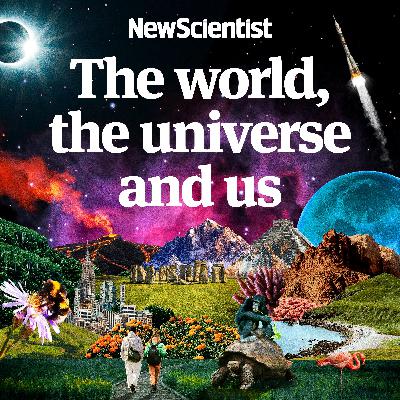
Top Science Stories of 2025 | The New Scientist Features Special - The world, the universe and us
Description
Episode 337
As we reach the end of the year, catch up on some of New Scientist’s most exciting and thought-provoking features of the past twelve months.
For decades we’ve got autism in girls all wrong. Symptoms present quite differently in girls to boys, meaning they often go undiagnosed. So why have we failed to see the differences - and why are girls so often neglected by autism research? We review a feature written by Gina Rippon - one of the scientists studying autism who admits to getting it wrong for years.
If you’re interested in living a longer life, you may have heard the name Bryan Johnson. He’s the tech millionaire who’s doing everything in his power to live as long as possible. From a 6.5 hour morning routine, to experimental gene treatments and hypoxia therapy - we dig into the life of the man whose slogan is “Don’t Die”.
There is no space, no time, no particles. This is the radical new quantum vision of reality proposed by physicist Vlatko Vedral. He argues that our current lens for looking at reality is full of problems, especially concerning observers - this idea that reality is somehow contingent on us looking at it. So what really lies beyond quantum theory?
Over tens of thousands of years, waves of Homo sapiens set out across Europe and Asia, only for their societies and cultures to mysteriously vanish. At last, ancient DNA from fossils is revealing why. We shed light on the lives of the LRJ people, a group of a few hundred ancient humans who roamed across Europe 43,000 years ago.
There are new hints that the fabric of space-time may be made of "memory cells" that record the whole history of the universe. If true, it could explain the nature of dark matter and much more. But how could pure emptiness ever remember, or store information? We discuss how Florian Neukart, the feature writer, has tested this theory inside a quantum computer.
Most of us see body fat as something we need to attack or get rid of. But we’re beginning to figure out just how important fat is for shaping our health and mind. The fat in our bodies is a communicative organ with a role in everything from bone health to mood. And it isn’t just one thing - it comes in various forms and colours, each with distinct functions and found in different locations. So do we need to respect fat a bit more?
A whole library’s worth of papyri owned by Julius Caesar’s father-in-law were turned to charcoal by the eruption of Vesuvius. But nearly 2000 years later, we can at last read these lost treasures. Discover how a particle accelerator is being used to decode messages once thought completely lost.
Our emotions can often get the better of us, taking control over our feelings and actions. But what if there were a way to harness your emotions for a happier, calmer life? Researcher Ethan Kross has found ways to do just that. Based on his own experience of his Grandmother’s resilience, who endured the trauma of Nazi occupation, he’s developed an actionable guide for anyone to master how they feel.
Hosted by Penny Sarchet, with guests Cat de Lange, Joshua Howgego and Claudia Canavan.
Learn more about your ad choices. Visit megaphone.fm/adchoices










 United States
